
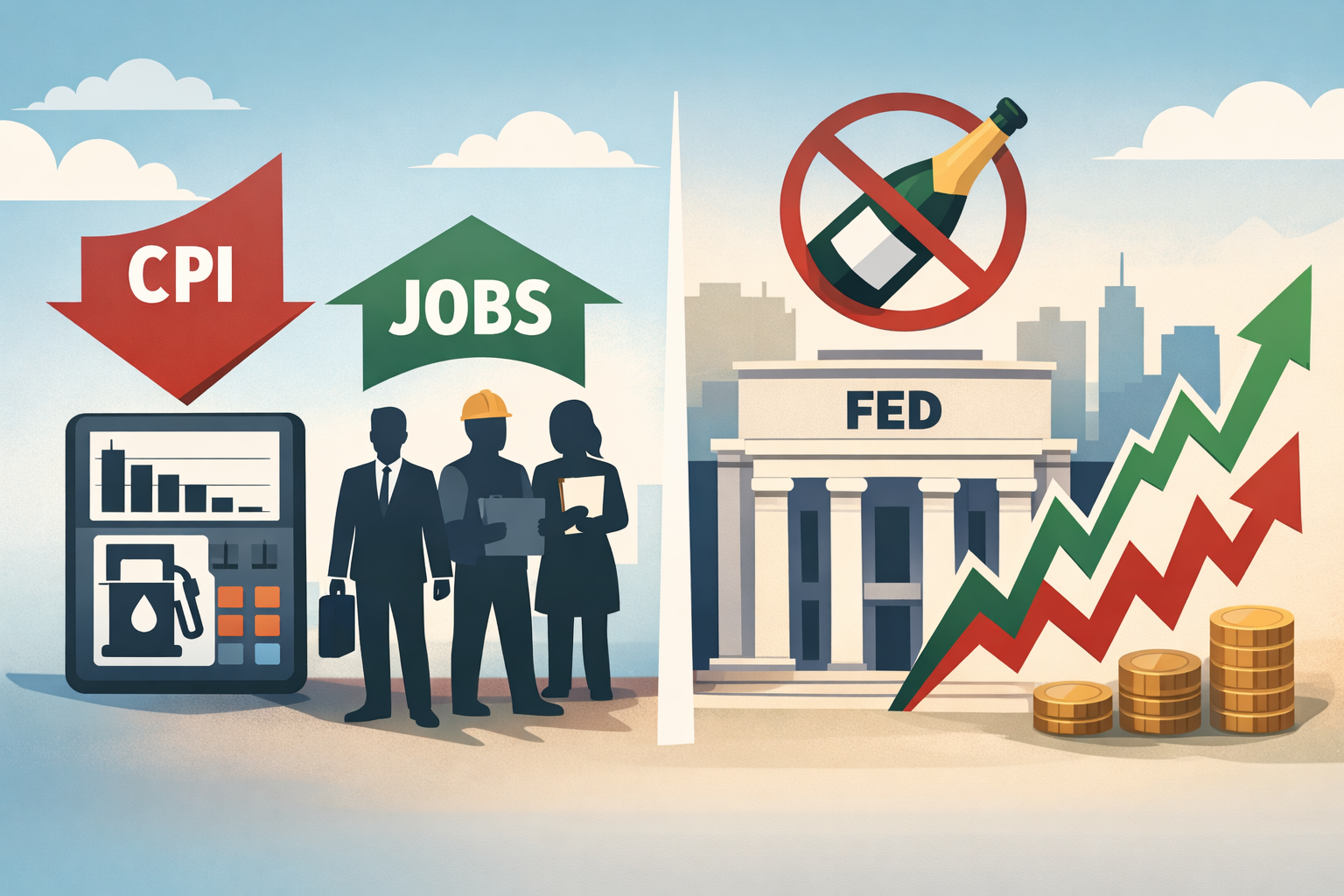
Last week seemed to be one of those “everything matters at the same time” type of weeks at the macroeconomic level. It is the kind of week that makes the stock exchange jump to a simple narrative, “inflation is dropping, therefore the Fed will make a cut next,” and then reality quietly reiterates to people that it is never that straightforward.
Let’s talk about jobs first because they are still the Fed’s leading indicator that it looks at the most. The U.S. economy created around 130,000 jobs in January, which is more than twice what many people had expected, while the rate of unemployment went down to 4.3%. That does not indicate that the labor market is breaking down. It is more likely an economy that keeps taking hits and still manages to get back on its feet. Even the weekly new jobless claims conformed to that story as the claims dropped to 227,000. Yes, it was a bit higher than what was expected, but it was less than the previous week, so the first one was more of a stabilization than a deterioration kind of thing. Plus, a labor force participation rate increasing to 62.5% reveals an important fact, people are getting in the game again because they believe that there are jobs to be had. That kind of trust is not something that generally appears in an economy that is weak.
Then there was the main story of the week, inflation. The Consumer Price Index (CPI) went up by 0.2% month over month, which was less than the forecast that pointed to 0.3%. On an annual basis, it was 2.4%, lower than the 2.5% that had been expected and down from 2.7% in December. That is a real cool-down, and it is the kind of number that makes investors begin to get too excited about rate cuts. But the farther you dig, the more reasons you find as to why the Fed will not open a bottle of champagne yet.
Core CPI—that is, without food and energy—came in at 0.3% on the month, exactly as expected, and 2.5% year over year, a barely better figure than the one reported in the previous month. In other words, prices are going up more slowly, but the rise in prices has not yet “broken” toward the Fed’s 2% target decisively. Some components are doing the heavy work, others remain stubborn, and the mixture is what matters.
Energy prices dropped by 1.5% over the month, which made a considerable contribution to the fall of the headline figure. Shelter, the largest component in the CPI basket, went up only by 0.2%, and that is a big thing because the market had been worried about the possibility of rents going up at a faster pace. On the other hand, airfares went up by 6.5%, thus transporting costs increased, which has pushed up core inflation. There were some counterbalances as used car prices fell 1.8% and some insurance categories also experienced a cooling. To wrap it all up, one does not see a general inflation resurgence but rather cross-currents with enough progress to be encouraging, but still not enough to declare victory.
So should the Fed lower interest rates right away? Hold on. The Fed has to perform a difficult juggling act, on the one hand the labor market is still very strong, wages are still going up at approximately 3.7% year over year, and unemployment is not spiraling out of control. On the other hand, inflation is gradually coming down, shelter seems to be less volatile, and energy has been helping the situation. According to this scenario, the most probable course of action in March will be for the Fed to do nothing. The Fed does not have to hurry—if it cuts too early, growth will speed up again and inflation will be back for another round. However, if the CPI keeps on dropping over the following few months, then the pressure for rate cuts will become huge, and the question will shift from “if” to “when.”
And that is where you, as a personal investor, can get simple investment advice from the whole story. Rather than trying to figure out if the first cut is going to come in April, June, or September—or constantly worrying about every single decimal place of the CPI—there is a more peaceful way. Just keep on buying, if cuts come thats great, if they are postponed it is also okay. If there is a surge in volatility, that can be a blessing in disguise when you are a monthly buyer. In the long run, discipline and horizon usually matter more than a single week of macro news.